Introduction
Quadratic inequalities can look intimidating at first, especially when students are unsure what to do after factorising the expression. The good news is that with the number line method, quadratic inequalities become much easier to understand.
In O Level A Maths, students often meet questions such as \(x^2 – 5x + 6 > 0\). Instead of guessing the answer, students should use a clear method: factorise, mark the critical values, test the intervals, and write the final solution correctly.
In this guide, we will break down quadratic inequalities step by step using the number line method so that students can solve them with more confidence.
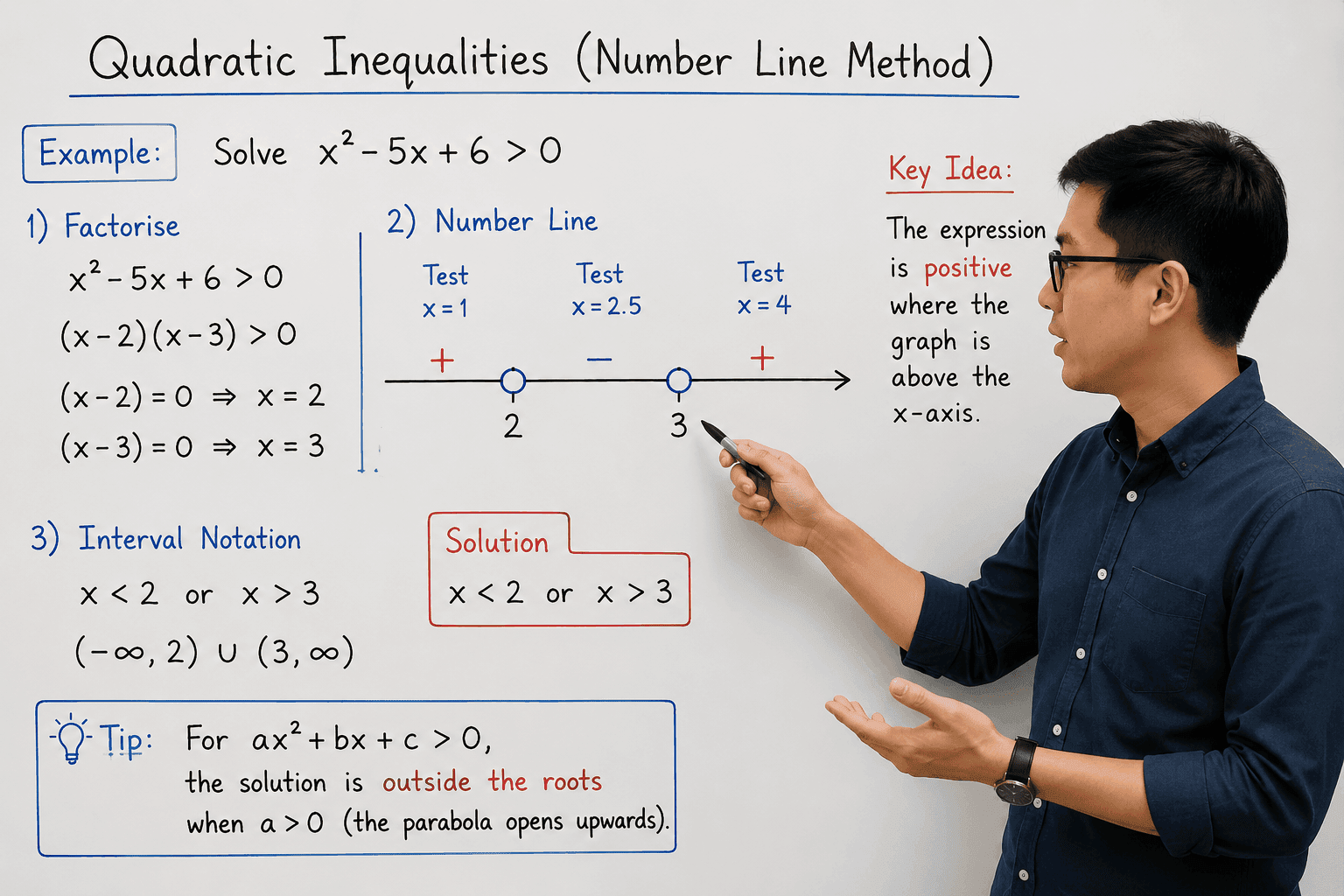
The Question / Scenario Explanation
Source: Quadratic inequalities made simple with the number line method
The screenshots show a worked example involving the inequality:
\(x^2 – 5x + 6 > 0\)
The video explains how to solve this by first factorising the quadratic expression, then using a number line to test where the expression is positive.
Start by factorising:
\(x^2 – 5x + 6 = (x – 2)(x – 3)\)
Then solve:
\((x – 2)(x – 3) > 0\)
The key values are \(x = 2\) and \(x = 3\). These values split the number line into three intervals:
- \(x < 2\)
- \(2 < x < 3\)
- \(x > 3\)
After checking each interval, the final answer is:
\(x < 2\) or \(x > 3\)
Step-by-Step Solution / Explanation
Step 1: Write Down the Inequality Clearly
The question is:
\(x^2 – 5x + 6 > 0\)
This means we want to find all values of \(x\) that make the quadratic expression positive.
Step 2: Factorise the Quadratic Expression
To solve this, first factorise \(x^2 – 5x + 6\).
We need two numbers that:
- multiply to give \(6\)
- add to give \(-5\)
These numbers are \(-2\) and \(-3\).
So:
\(x^2 – 5x + 6 = (x – 2)(x – 3)\)
Now the inequality becomes:
\((x – 2)(x – 3) > 0\)
Step 3: Find the Critical Values
The critical values are the values of \(x\) that make either factor equal to zero.
\(x – 2 = 0 \Rightarrow x = 2\)
\(x – 3 = 0 \Rightarrow x = 3\)
These values are important because they divide the number line into separate intervals.
Step 4: Draw and Split the Number Line
Mark \(2\) and \(3\) on a number line. This creates three intervals:
- \(x < 2\)
- \(2 < x < 3\)
- \(x > 3\)
Now test one value from each interval.
Step 5: Test the Interval \(x < 2\)
Choose a convenient value such as \(x = 0\).
Substitute into \(x^2 – 5x + 6\):
\(0^2 – 5(0) + 6 = 6\)
\(6 > 0\)
This is true, so the interval \(x < 2\) is part of the solution.
Step 6: Test the Interval \(2 < x < 3\)
Choose a value such as \(x = 2.5\).
Substitute into \(x^2 – 5x + 6\):
\((2.5)^2 – 5(2.5) + 6\)
\(6.25 – 12.5 + 6 = -0.25\)
\(-0.25 > 0\)
This is false, so the interval \(2 < x < 3\) is not part of the solution.
Step 7: Test the Interval \(x > 3\)
Choose a value such as \(x = 4\).
Substitute into \(x^2 – 5x + 6\):
\(4^2 – 5(4) + 6\)
\(16 – 20 + 6 = 2\)
\(2 > 0\)
This is true, so the interval \(x > 3\) is part of the solution.
Step 8: State the Final Answer Correctly
The intervals that satisfy the inequality are:
\(x < 2\) and \(x > 3\)
So the final answer is:
\(x < 2\text{ or }x > 3\)
Because the inequality is \(> 0\), the values \(x = 2\) and \(x = 3\) are not included.
Step 9: Understand Why the Middle Interval Does Not Work
Between \(2\) and \(3\), one factor is positive and the other is negative.
For example, when \(x = 2.5\):
\(x – 2\) is positive, but \(x – 3\) is negative.
A positive number multiplied by a negative number gives a negative result. That is why the middle interval does not satisfy the inequality.
Key Concepts Students Must Know
- Quadratic inequalities are solved differently from quadratic equations because we are finding intervals, not just single values.
- Factorising helps turn the quadratic expression into two linear factors.
- The values that make each factor zero are called critical values.
- The number line method helps students check which intervals make the expression positive or negative.
- If the inequality is \(> 0\), we want positive intervals. If it is \(< 0\), we want negative intervals.
- If the inequality is strict, such as \(> 0\) or \(< 0\), the boundary values are not included.
Exam Tips / Common Mistakes
Exam Tips
- Always factorise the quadratic expression first if possible.
- Mark the critical values clearly on a number line.
- Test one value from each interval instead of guessing.
- Check whether the question wants positive or negative values.
- Write the final answer using inequality notation correctly.
- Look carefully at whether the inequality is strict or inclusive.
Common Mistakes
- Solving the expression as if it were a quadratic equation and stopping at \(x = 2\) and \(x = 3\).
- Forgetting to test the intervals on the number line.
- Choosing the wrong intervals for the final answer.
- Including \(x = 2\) or \(x = 3\) when the inequality is \(> 0\).
- Missing the word “or” in the final answer.
- Not checking whether the middle interval is positive or negative.
When solving quadratic inequalities, students must remember that the answer usually involves a range of values, not just the roots.
Parent Insight
Many parents notice that students can solve quadratic equations but become confused when the question changes into an inequality. This happens because students often know how to factorise but do not yet understand how to interpret the sign of the expression across different intervals.
A good way to support your child is to ask guiding questions such as:
- “What are the critical values?”
- “How many intervals does the number line have?”
- “What value can you test in this interval?”
- “Is the result positive or negative?”
This helps students move beyond memorising steps and understand why the number line method works.
Conclusion
Quadratic inequalities become much more manageable when students use the number line method. For the example \(x^2 – 5x + 6 > 0\), we first factorise to get \((x – 2)(x – 3) > 0\), then use the critical values \(2\) and \(3\) to split the number line and test the intervals.
After checking the intervals, we find that the expression is positive when:
\(x < 2\text{ or }x > 3\)
With regular practice, students will find that this method is one of the clearest and most reliable ways to solve quadratic inequalities in O Level A Maths.
Visit our homepage: Click Here…
Read more on our blog: Click Here…
Start here (limited slots weekly):
Free Trial: Click Here…
Enroll: Click Here…
Explore our main tuition brand approach here: Click Here…