Introduction
If someone offered you \( \$1,000,000 \) today or a penny that doubles every day for \(30\) days, which would you choose? Most people would quickly take the million dollars. However, the doubling penny problem shows how powerful exponential growth can be.
In O Level A Maths, exponential growth appears when a quantity increases by the same multiplier repeatedly. For the doubling penny example, the amount doubles each day, which means it is multiplied by \(2\) again and again.
This question is a great way to understand why exponential growth can start slowly but become surprisingly large over time.
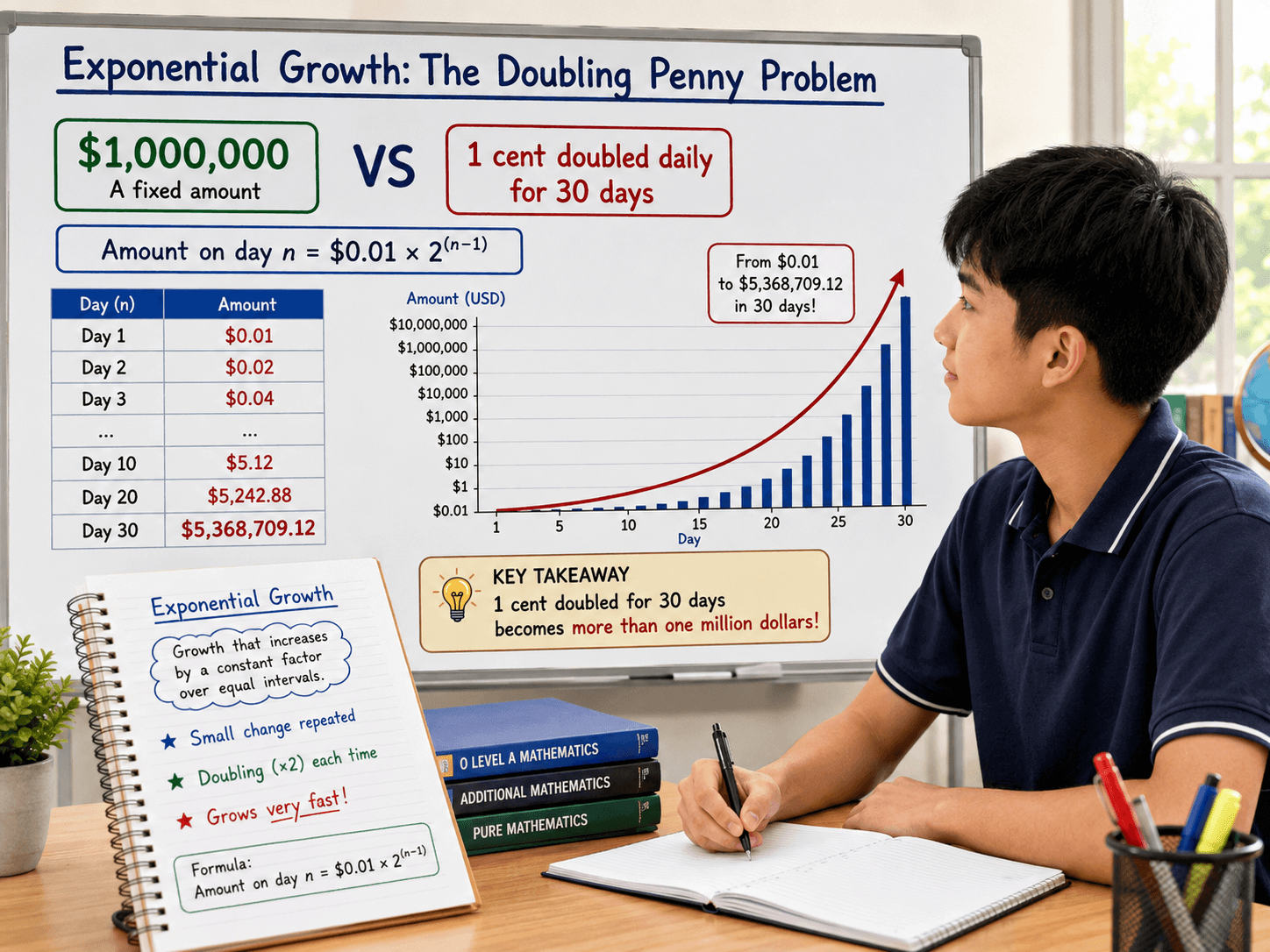
The Question / Scenario Explanation
Source: $1M or a doubling penny? The math will shock you
The screenshots present a choice:
- Take \( \$1,000,000 \) right now, or
- Take \( \$0.01 \) that doubles every day for \(30\) days.
At first, \( \$0.01 \) looks tiny compared to \( \$1,000,000 \). But because the amount keeps doubling, the growth becomes much faster as the days pass.
The general exponential model shown is:
\(y = a(b)^x\)
For this situation:
- \(a = 0.01\), the starting amount in dollars
- \(b = 2\), because the amount doubles
- \(x = 29\), because Day \(1\) starts at \( \$0.01 \), so Day \(30\) has doubled \(29\) times
So the amount on Day \(30\) is:
\(y = 0.01 \times 2^{29}\)
This gives:
\( \$5,368,709.12 \)
Step-by-Step Solution / Explanation
Step 1: Understand the Starting Amount
The penny starts at \( \$0.01 \) on Day \(1\).
This means the first term is:
\(a = 0.01\)
Although the amount is very small at the beginning, the important part is that it doubles every day.
Step 2: Understand What “Doubles Every Day” Means
If an amount doubles, it is multiplied by \(2\).
So the growth factor is:
\(b = 2\)
That means:
- Day \(1\): \( \$0.01 \)
- Day \(2\): \( \$0.02 \)
- Day \(3\): \( \$0.04 \)
- Day \(4\): \( \$0.08 \)
This may still look small at first, but the repeated doubling becomes very powerful later.
Step 3: Use the Exponential Growth Formula
A simple exponential growth formula is:
\(y = a(b)^x\)
where:
- \(y\) is the final amount
- \(a\) is the starting amount
- \(b\) is the multiplier
- \(x\) is the number of times the amount changes
For the doubling penny problem:
\(a = 0.01\)
\(b = 2\)
\(x = 29\)
Step 4: Why Do We Use \(2^{29}\) Instead of \(2^{30}\)?
This is an important exam-style detail.
On Day \(1\), the amount is already \( \$0.01 \). It has not doubled yet.
From Day \(1\) to Day \(30\), the amount doubles \(29\) times.
So we use:
\(2^{29}\)
not:
\(2^{30}\)
This is a common mistake in exponential growth questions.
Step 5: Calculate the Day 30 Amount
Now substitute into the formula:
\(y = 0.01 \times 2^{29}\)
Since:
\(2^{29} = 536870912\)
Then:
\(y = 0.01 \times 536870912\)
\(y = 5368709.12\)
So the amount is:
\( \$5,368,709.12 \)
Step 6: Compare It with \( \$1,000,000 \)
Now compare the two choices:
- Choice A: \( \$1,000,000 \)
- Choice B: \( \$5,368,709.12 \)
The doubling penny gives more money after \(30\) days.
Difference:
\(5368709.12 – 1000000 = 4368709.12\)
So the penny option gives:
\( \$4,368,709.12 \) more than \( \$1,000,000 \)
Step 7: Understand the Main Lesson
The main lesson is that exponential growth can look slow at the start but become extremely fast later.
This happens because the increase is not constant. It gets bigger each time because the whole amount is doubling.
That is why the doubling penny example is such a strong way to understand exponential growth.
Key Concepts Students Must Know
- Exponential growth uses repeated multiplication: The quantity is multiplied by the same factor again and again.
- Doubling means multiplying by \(2\): In this example, the penny doubles every day.
- The starting amount matters: The penny starts at \( \$0.01 \).
- The exponent counts the number of doublings: From Day \(1\) to Day \(30\), there are \(29\) doublings.
- Exponential growth starts slowly but grows quickly later: This is why the final amount becomes so large.
Exam Tips / Common Mistakes
Exam Tips
- Identify the starting value before writing the formula.
- Check whether the question starts counting from Day \(0\) or Day \(1\).
- Use the multiplier carefully. If something doubles, the multiplier is \(2\).
- Write the exponential model clearly before calculating.
- Compare the final result with the alternative option if the question asks for a decision.
Common Mistakes
- Using \(2^{30}\) instead of \(2^{29}\) when Day \(1\) is already \( \$0.01 \).
- Forgetting to convert one cent into \( \$0.01 \).
- Adding instead of multiplying repeatedly.
- Thinking exponential growth is small because it starts small.
- Writing the final answer without dollars and cents.
For exponential growth questions, students must always check what the exponent represents. In this example, \(x = 29\) because the amount doubles \(29\) times by Day \(30\).
Parent Insight
Parents may notice that students often underestimate exponential growth because the early values look small. This is very common. The doubling penny example is useful because it makes the idea visual and surprising.
Instead of only memorising formulas, students should understand the pattern:
- The amount starts small.
- It doubles repeatedly.
- The increase becomes larger and larger.
- The final value can become much bigger than expected.
Parents can ask simple guiding questions such as:
- “How much is the starting amount?”
- “What is the multiplier each day?”
- “How many times has it doubled by Day \(30\)?”
- “Is this linear growth or exponential growth?”
These questions help students think through the structure of the problem instead of rushing into calculator work.
Conclusion
The doubling penny problem shows how powerful exponential growth can be. Although \( \$0.01 \) looks tiny at first, doubling it every day for \(30\) days gives:
\(0.01 \times 2^{29} = 5368709.12\)
So the final amount is:
\( \$5,368,709.12 \)
This is much more than \( \$1,000,000 \). The key takeaway is that exponential growth may start slowly, but it can increase very quickly when the multiplier is repeated many times.
Visit our homepage: Click Here…
Read more on our blog: Click Here…
Start here (limited slots weekly):
Free Trial: Click Here…
Enroll: Click Here…
Explore our main tuition brand approach here: Click Here…