Introduction
Many students feel nervous when they first see logarithms in O Level Additional Maths. The notation can look unfamiliar, and the questions may seem harder than they really are. However, understanding logarithms becomes much easier once students realise that a logarithm is simply asking one question: What power do I need?
That is the big idea behind logarithms. Instead of seeing log questions as something abstract, students can treat them as power questions. Once this is clear, many standard A Maths questions become more manageable.
In this guide, we will break down understanding logarithms step by step, using simple examples such as \( \log_{10} 100 \), \( \log_{2} 32 \), and the key rule \( \log_{a} b = c \iff a^c = b \).
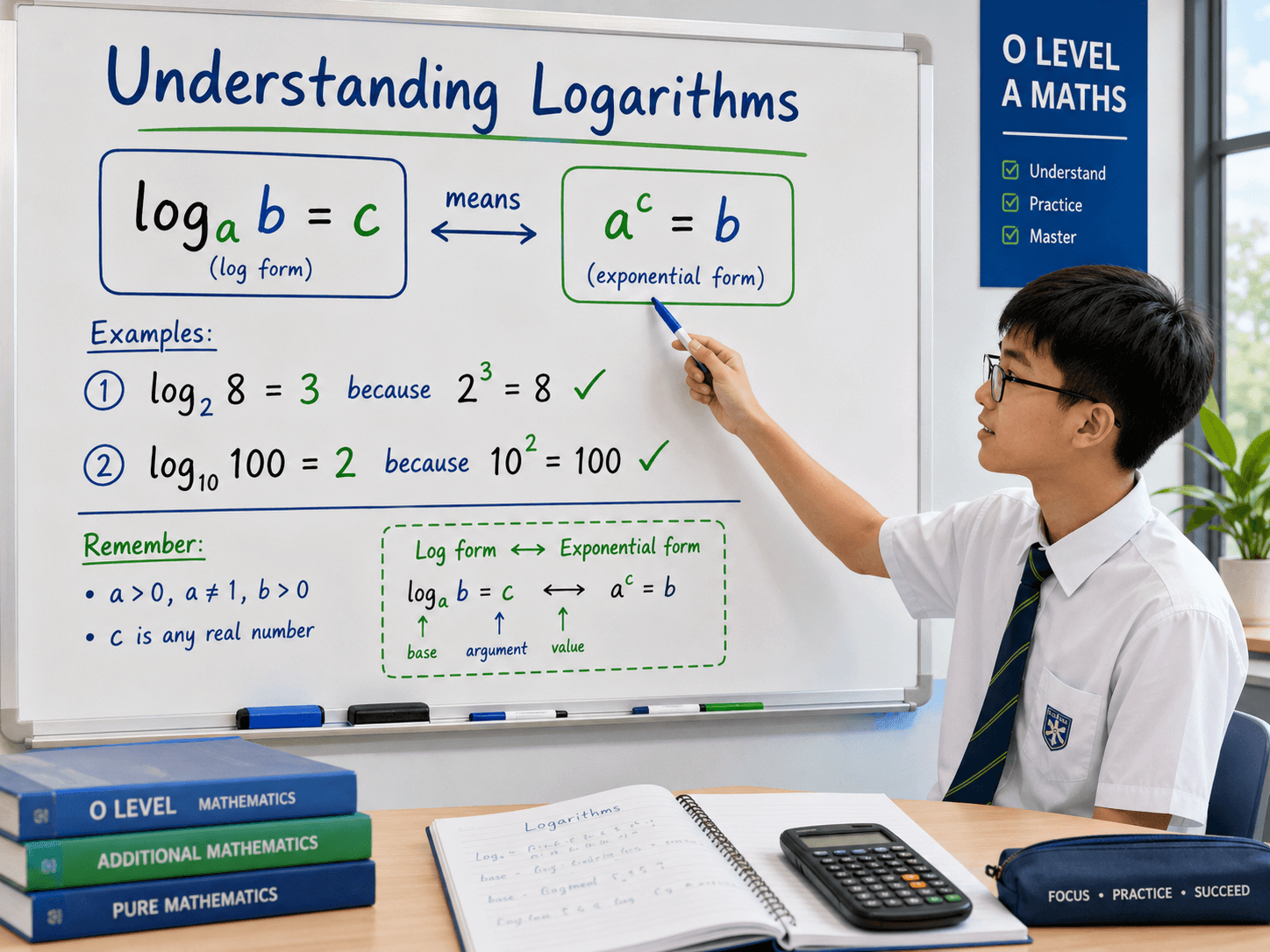
The Question / Scenario Explanation
Source: Logarithms aren’t scary. They’re just a question.
The screenshots show a teacher explaining logarithms using the idea of powers. One of the first examples shown is:
\(10^2 = 100\)
From this, the equivalent logarithmic form is written as:
\(\log_{10} 100 = 2\)
The teacher then generalises the idea:
\(\log_{a} b = c\)
This means:
\(a^c = b\)
In other words, a logarithm is asking: What power of \(a\) gives \(b\)?
The screenshots also point to examples such as:
- \(\log_{2} 32\)
- \(\log_{2} 64\)
- \(\log_{10} 1000\)
- \(\log_{3} 27\)
This is exactly why understanding logarithms is so important. Once students can switch between logarithmic form and index form, many questions become straightforward.
Step-by-Step Solution / Explanation
Step 1: Start with the Meaning of a Logarithm
A logarithm tells us the power that a base must be raised to in order to get a given number.
The general form is:
\(\log_{a} b = c\)
This means:
\(a^c = b\)
So when students see a logarithm, they should immediately think about powers or indices.
Step 2: Understand the Basic Example \( \log_{10} 100 = 2 \)
Let us look at this example:
\(\log_{10} 100 = 2\)
This means:
What power of \(10\) gives \(100\)?
Since:
\(10^2 = 100\)
the answer is \(2\).
So:
\(\log_{10} 100 = 2\)
This is one of the easiest ways to begin understanding logarithms.
Step 3: Learn the Key Rule
The most important rule students must remember is:
\(\log_{a} b = c \iff a^c = b\)
This is the rule that lets students convert between logarithmic form and exponential form.
For example:
- \(\log_{2} 8 = 3\) because \(2^3 = 8\)
- \(\log_{5} 25 = 2\) because \(5^2 = 25\)
- \(\log_{3} 27 = 3\) because \(3^3 = 27\)
If students remember this one relationship, they already have a strong foundation for many log questions.
Step 4: Solve \( \log_{2} 32 \)
Now let us apply the rule:
\(\log_{2} 32 = ?\)
This means:
What power of \(2\) gives \(32\)?
Write out the powers of \(2\):
\(2 \times 2 \times 2 \times 2 \times 2 = 32\)
So:
\(2^5 = 32\)
Therefore:
\(\log_{2} 32 = 5\)
Step 5: Solve More Similar Examples
Example 1:
\(\log_{3} 27 = ?\)
Ask:
What power of \(3\) gives \(27\)?
Since:
\(3^3 = 27\)
Therefore:
\(\log_{3} 27 = 3\)
Example 2:
\(\log_{2} 64 = ?\)
Ask:
What power of \(2\) gives \(64\)?
Since:
\(2^6 = 64\)
Therefore:
\(\log_{2} 64 = 6\)
Example 3:
\(\log_{10} 1000 = ?\)
Ask:
What power of \(10\) gives \(1000\)?
Since:
\(10^3 = 1000\)
Therefore:
\(\log_{10} 1000 = 3\)
Step 6: Know How to Change from Log Form to Index Form
When a question gives:
\(\log_{a} b = c\)
students should rewrite it as:
\(a^c = b\)
This is often the easiest way to solve the question.
For example:
\(\log_{4} 64 = x\)
Rewrite as:
\(4^x = 64\)
Since:
\(4^3 = 64\)
Therefore:
\(x = 3\)
Step 7: Recognise the Reverse Process Too
Students should also be comfortable going the other way.
If they see:
\(7^2 = 49\)
they should know that the equivalent logarithmic form is:
\(\log_{7} 49 = 2\)
This flexibility is essential for understanding logarithms well in Additional Maths.
Key Concepts Students Must Know
- A logarithm asks for a power: It tells us what exponent is needed.
- Main rule: \(\log_{a} b = c\) means \(a^c = b\).
- The base matters: In \(\log_{2} 32\), the base is \(2\), so students should think in powers of \(2\).
- Logarithmic and exponential forms are equivalent: Students should be able to switch between them confidently.
- Many simple log questions can be solved by recognising powers: This is often quicker than trying to memorise too many rules at once.
Exam Tips / Common Mistakes
Exam Tips
- Whenever you see a logarithm, ask: “What power do I need?”
- Rewrite the question in index form if it feels clearer.
- Check the base carefully before answering.
- Memorise common powers of \(2\), \(3\), \(5\), and \(10\) to speed up working.
- Show the equivalent exponential form in your working if the question requires explanation.
Common Mistakes
- Ignoring the base and focusing only on the number.
- Mixing up \(\log_{a} b = c\) with \(a^b = c\).
- Forgetting that the answer to a logarithm is an exponent.
- Writing the wrong power when the value is a familiar number like \(32\) or \(64\).
- Trying to memorise results without understanding the meaning of the log.
For example, in \(\log_{2} 32\), the answer is not \(32\) and not \(2\). The answer is the exponent \(5\), because \(2^5 = 32\).
Parent Insight
Parents often hear that Additional Maths topics are “hard”, and logarithms are one of those topics that students may fear because of the notation. In reality, many students struggle not because the topic is impossible, but because the meaning is not made clear early enough.
If your child can already work with indices, then logarithms are simply the reverse idea. One useful question parents can ask is:
“What power gives this answer?”
That question alone can guide the child back to the meaning of the logarithm.
For example:
- What power of \(2\) gives \(32\)?
- What power of \(10\) gives \(1000\)?
- What power of \(3\) gives \(27\)?
This helps students see that logarithms are not random symbols. They are simply another way of writing powers.
Conclusion
Understanding logarithms becomes much easier when students remember one central idea: a logarithm asks for a power.
The key rule is:
\(\log_{a} b = c \iff a^c = b\)
Using this rule, students can solve examples such as:
- \(\log_{10} 100 = 2\)
- \(\log_{2} 32 = 5\)
- \(\log_{3} 27 = 3\)
- \(\log_{2} 64 = 6\)
With practice, students can stop seeing logarithms as scary and start seeing them as logical, structured, and manageable.
Visit our homepage: Click Here…
Read more on our blog: Click Here…
Start here (limited slots weekly):
Free Trial: Click Here…
Enroll: Click Here…
Explore our main tuition brand approach here: Click Here… .