Introduction
This trapezium surds question is a strong O Level A Maths example because it combines area of a trapezium, algebraic rearrangement, and surd rationalisation in one problem. Many students know the trapezium formula, but they lose marks when they need to keep everything in exact form. Once the equation is set up carefully, this trapezium surds question becomes very systematic.
The Question / Scenario Explanation
Source: SURDS O Level 2025 Paper 2 A.Maths
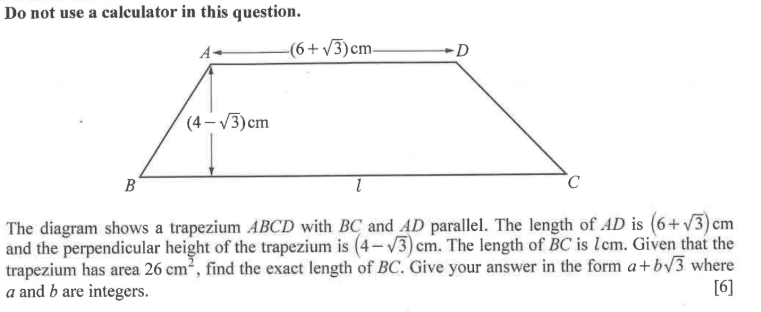
Question (as shown): The diagram shows a trapezium \(ABCD\) with \(BC\) and \(AD\) parallel. The length of \(AD\) is \((6+\sqrt{3})\) cm and the perpendicular height of the trapezium is \((4-\sqrt{3})\) cm. The length of \(BC\) is \(l\) cm. Given that the trapezium has area \(26\text{ cm}^2\), find the exact value of \(BC\). Give your answer in the form \(a+b\sqrt{3}\), where \(a\) and \(b\) are integers.
Step-by-Step Solution / Explanation
Step 1: Use the trapezium area formula
For this trapezium surds question, use:
\(\text{Area}=\frac{1}{2}\times(\text{sum of parallel sides})\times\text{height}\)
So:
\(26=\frac{1}{2}\big((6+\sqrt{3})+l\big)(4-\sqrt{3})\)
Step 2: Remove the fraction
Multiply both sides by \(2\):
\(52=\big((6+\sqrt{3})+l\big)(4-\sqrt{3})\)
Now divide both sides by \((4-\sqrt{3})\):
\((6+\sqrt{3})+l=\frac{52}{4-\sqrt{3}}\)
Step 3: Rationalise the denominator
To solve this trapezium surds question exactly, rationalise the denominator:
\(\frac{52}{4-\sqrt{3}} \times \frac{4+\sqrt{3}}{4+\sqrt{3}}=\frac{52(4+\sqrt{3})}{16-3}\)
\(=\frac{52(4+\sqrt{3})}{13}\)
\(=4(4+\sqrt{3})\)
\(=16+4\sqrt{3}\)
Step 4: Find \(l\)
We now have:
\((6+\sqrt{3})+l=16+4\sqrt{3}\)
So:
\(l=16+4\sqrt{3}-(6+\sqrt{3})\)
\(l=10+3\sqrt{3}\)
✅ Final Answer: \(BC=l=10+3\sqrt{3}\text{ cm}\)
Step 5: Quick check
If \(l=10+3\sqrt{3}\), then the sum of the parallel sides is:
\((6+\sqrt{3})+(10+3\sqrt{3})=16+4\sqrt{3}\)
Area \(=\frac{1}{2}(16+4\sqrt{3})(4-\sqrt{3})\)
\(=\frac{1}{2}(64-16\sqrt{3}+16\sqrt{3}-12)\)
\(=\frac{1}{2}(52)=26\) ✅
So the answer is correct.
Key Concepts Students Must Know
- In a trapezium surds question, start with the correct area formula: \(\frac{1}{2}(\text{sum of parallel sides})(\text{height})\).
- Keep everything in exact form. Do not change surds into decimals.
- When a surd appears in the denominator, rationalise it using the conjugate.
- Always simplify the final answer into the required form, here \(a+b\sqrt{3}\).
Exam Tips / Common Mistakes
Exam Tips
- Write the trapezium formula clearly before substituting values.
- For this trapezium surds question, keep brackets neat when writing \((6+\sqrt{3})+l\).
- Use the conjugate carefully when rationalising: \(4-\sqrt{3}\) pairs with \(4+\sqrt{3}\).
- Check that your final answer is in exact form and not a decimal approximation.
- Do a quick substitution check back into the area formula if time allows.
Common Mistakes
- Forgetting the \(\frac{1}{2}\) in the trapezium area formula.
- Using only one parallel side instead of adding both \(AD\) and \(BC\).
- Rationalising \(\frac{52}{4-\sqrt{3}}\) incorrectly.
- Making a sign error when subtracting \((6+\sqrt{3})\) from \(16+4\sqrt{3}\).
- Giving an approximate decimal answer even though the question asks for an exact surd form.
Parent Insight
This trapezium surds question is a good example of how O Level A Maths often blends geometry and algebra in the same problem. Students may know both topics separately, but they need practice combining them smoothly. With guided working, children learn to set up the formula, rearrange confidently, and handle surds accurately without relying on a calculator.
Conclusion
To solve this trapezium surds question, we used the trapezium area formula, substituted the given parallel side and height, and formed an equation in \(l\). After rationalising \(\frac{52}{4-\sqrt{3}}\), we found that \(l=10+3\sqrt{3}\). Therefore, the exact length of \(BC\) is \(10+3\sqrt{3}\text{ cm}\).
Visit our A Maths homepage: Click Here…
Read more A Maths tips and worked examples here: Click Here…
Start here (limited slots weekly):
Free Trial: Click Here…
Enroll: Click Here…
Explore our main tuition brand approach here: Click Here… .